
SKU is short for Stock Keeping Unit, a unique code assigned to each product variation for identification, tracking, and inventory control.
An SKU helps organise products, manage stock movement, analyse sales, and improve supply-chain accuracy across sourcing, warehousing, and fulfilment operations.
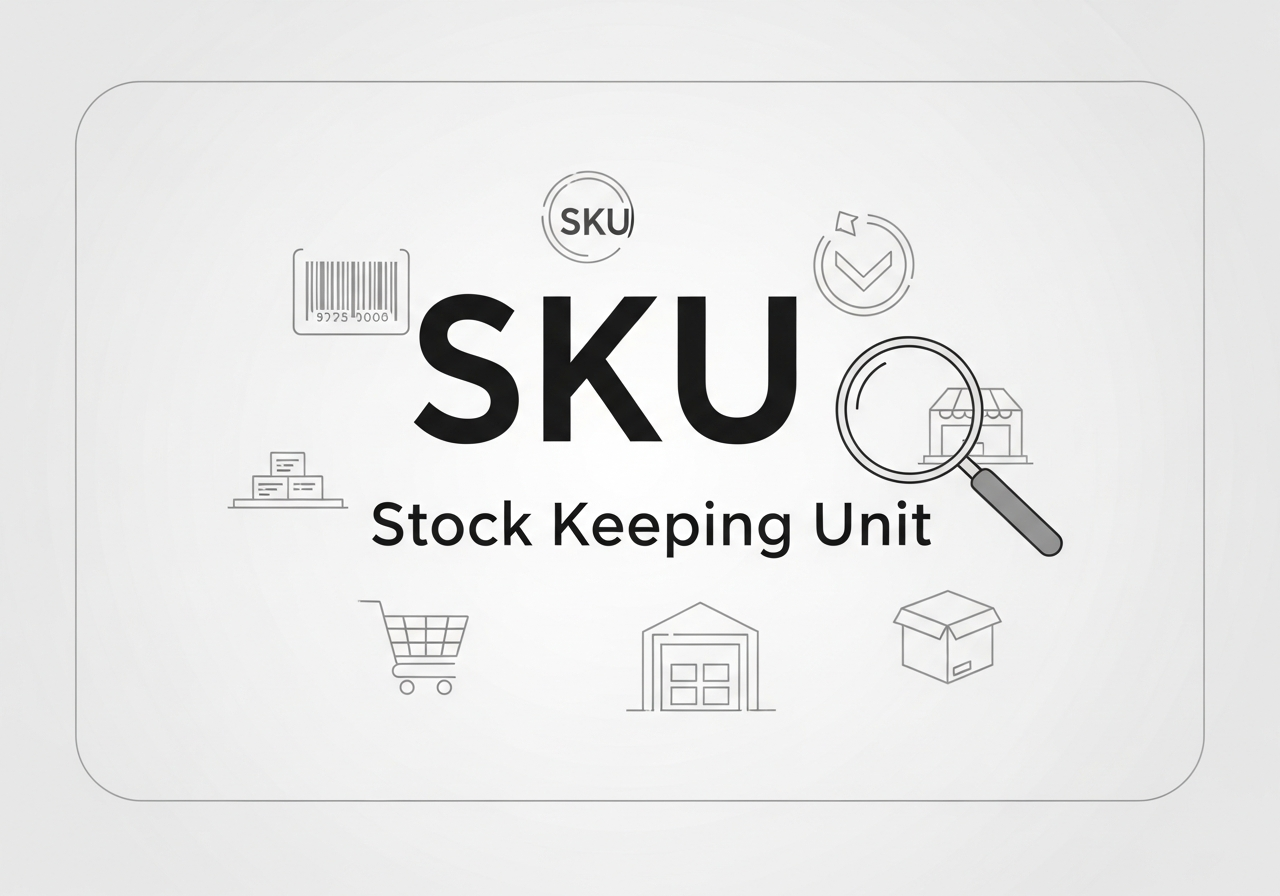
SKU systems are foundational in modern commerce. Clear SKU structures streamline catalog management, support accurate replenishment, and reduce fulfilment errors across retail, e-commerce, and global import operations.
What exactly does “SKU” represent?

SKU codes represent specific product attributes such as size, colour, material, or model.
Each SKU is a unique identifier for a single product variant used internally for inventory and operational tracking.
Key characteristics of an SKU
An SKU is:
- Internal (defined by the organisation)
- Attribute-based (e.g., “Jersey-BLK-L”)
- Operational (used for stock counting, picking, packing, and reporting)
SKUs differ from barcodes/UPCs, which are global identifiers. SKUs are created according to the internal product logic of the business, making them flexible and customisable.
Why SKU clarity matters
A structured SKU system supports smooth procurement, accurate inventory reconciliation, and clear separation of look-alike products.
In complex supply chains—especially those involving multiple factories or packaging variations—a well-built SKU system prevents mix-ups and reduces handling time.
How can SKUs improve inventory accuracy?
Accurate inventory depends on clear product identification.
A precise SKU system reduces stock discrepancies, improves warehouse efficiency, and provides real-time visibility of product availability.
How SKUs strengthen operational control
1. Faster stock counting
Warehouse staff can count and scan items efficiently when each product variant has a unique identifier.
2. Better stock forecasting
SKU-level data reveals which variants sell fastest and which require replenishment.
3. Reduced picking and packing errors
Clear SKU labels reduce wrong-item shipments, improving fulfilment accuracy.
4. Streamlined returns management
Returned items are matched to the correct SKU, simplifying restocking workflows.
Operational gains in import workflows
Consistent SKUs across supplier invoices, packing lists, and warehouse receipts reduce discrepancies during customs checks and prevent delays caused by mismatched descriptions or quantities.
How do SKUs support sales and catalogue management?

SKUs structure product information in a way that enables better analysis, pricing control, and merchandising decisions.
SKU-level data reveals buying patterns, identifies top sellers, and highlights underperforming items.
Benefits for catalogue optimisation
1. Product performance insights
Analysing sales by SKU helps identify high-margin and fast-moving variants.
2. Clearer pricing structures
SKU segmentation allows precise price testing and promotional control.
3. Easier marketplace management
Platforms such as Amazon, eBay, and Shopify rely heavily on SKU consistency for listing accuracy, stock sync, and automatic order routing.
Role in international sourcing
When dealing with variations from multiple suppliers, SKU consistency ensures coherent cost comparison, unified reordering, and error-free repackaging before export.
How can SKUs improve supply-chain and warehouse operations?
SKU systems coordinate procurement, inbound receiving, put-away, and outbound fulfilment.
Well-designed SKUs simplify logistics operations, reduce lead times, and lower error rates in both manual and automated warehouses.

Supply-chain advantages
1. Precise purchasing
SKU-level order placement avoids ambiguity and ensures suppliers produce exactly the required variant.
2. Enhanced traceability
Batch codes, lot numbers, and expiry data can be attached to SKUs for regulated products.
3. Superior warehouse layout
Grouping SKUs based on velocity (fast vs slow movers) improves picking routes and resource planning.
4. Seamless multi-supplier consolidation
Uniform SKUs allow easier cross-checking between supplier documents, reducing discrepancies when shipments are combined for export.
Impact on final delivery
Correct SKU labeling reduces misshipments and improves delivery accuracy, especially when distributing to multiple retail or warehouse destinations.
Conclusion
A structured SKU system forms the backbone of efficient merchandising, inventory management, and supply-chain operations.
Clear SKU logic enhances forecasting, catalogue control, and operational accuracy while reducing fulfilment errors and stock discrepancies.
Across sourcing, warehousing, and distribution, SKU consistency improves traceability and cost visibility, supporting scalable and reliable logistics performance.
Adopting a disciplined SKU framework strengthens overall operational efficiency and enables long-term growth in retail and e-commerce environments.

 Chinese
  English